Traditional Karate
Weekly Newsletter • 28 February 2026
Weekly Update from Wadō-Ryū Benkyō
Hello, welcome to your 12th weekly update from Wadō-Ryū Benkyō. Below you’ll find this week’s notes, the latest long-format video, a featured article, course updates, and this week’s principle.
🥋 1. Saturday Benkyō Class Review – Today’s Training
Today’s training was a retrospective on key takeaways from the Winter Course — an opportunity to strip Kihon right back to its true fundamentals: movement, balance, timing, and posture.
The focus was on removing speed entirely and replacing it with smooth, consistent movement from start to finish. Rather than blending techniques together or rushing transitions, we worked on finishing one technique precisely where the next begins, creating a continuous and flowing approach to kihon waza.
Using Junzuki as our primary example, we examined the movement from Yoi into Junzuki hidari in detail. The emphasis was on understanding where the body is, where it needs to be, and what must occur for the transition to happen correctly. Instead of forcing the arm forward, we allowed it to leave the body as a natural result of coordinated movement. The weight shifted subtly over the posting knee as the body turned smoothly into its final position — controlled, measured, and connected. From there, the next technique became not a separate action, but a continuation of the first.
Applying the same principles to Gyakuzuki, we explored how the body must find a new balance point. With the hips now closed and the focus subtly adjusted over the front leg, the centre of the body changes. We worked carefully to locate that new natural position while keeping the back neutral and aligned. After breaking Gyakuzuki down into its core components, we examined the transition from Junzuki using sonoba ippon toru, ensuring the body and technique never retreat or pull backward, but continue to project forward with only the smallest necessary shift — maintaining range and intention.
The final part of the session looked at the inverse through Shuto Uke, with a detailed breakdown of hiraki-ashi movement and sansoku footwork. Here, weight distribution shifted to a 70/30 balance behind the body, in contrast to Junzuki and Gyakuzuki dachi where weight projects forward. Despite this difference, the underlying principles remained the same: smooth movement, correct balance, structural awareness, and complete execution. We related these movements back to Seishan to give context and practical anchor points for future training. As always on a Saturday, the two hours seemed to evaporate — leaving tired bodies, active minds, and a deeper understanding of the subtle mechanics that make Wadō-Ryū movement distinctive.
A brilliant and intense session, and one that rewarded careful attention to detail.
If you are interested in experience this level of excellent tution Saturday sessions will run through until the end of 2026 — we will be training all through March 2026. If you would like to attend a Saturday session for the first time, please reply to the newsletter or check the events calendar here.
🎥 2. This Week’s Long-Format Video
Part 20 – Kette Junzuki — Kihon Fundamentals
Watch here: https://youtu.be/LdNvooH2QAE
Kihon Fundamentals – Kette Junzuki: Technical Breakdown
with Roger Vickerman Renshi (7th Dan) and Kash Bansal
In this volume of the Kihon Fundamentals series, Roger Vickerman Renshi and Kash Bansal examine Kette Junzuki — a technique often misunderstood as simply a kick followed by a punch. In Wadō-Ryū, however, Kette Junzuki is not “half a maegeri and half a junzuki,” but the complete integration of both elements into one continuous, structurally connected action.
The session focuses on how posture, balance, timing, and correct weight distribution allow Kette Junzuki to function as a unified technique. Emphasis is placed on understanding that the kette (the kick phase) is itself a complete action, not merely preparation for the punch. When performed correctly, the hips, centre, and supporting leg work together to remove unnecessary tension, allowing the technique to flow naturally without vertical rise or interruption.
Key areas explored include:
- Understanding Kette Junzuki as a unified technique, not two separate movements
- The role of posture in generating impact and maintaining balance
- Using hips and centre to drive the technique without tension
- Avoiding vertical lift or braking between kick and punch
- Applying Wadō principles such as dōsa, ryūsui, shizumu, and omomi
- Integrating Kette Junzuki into kihon, kumite, and partner application
📝 3. Featured Article of the Week
Jitte Kata – The Final Temple Kata
Jitte (十手) is a powerful and historically rich kata within the Wadō-Ryū syllabus, often regarded as a companion to Jion in the “Temple Kata” grouping. Meaning “Ten Hands,” the kata suggests versatility and control, reflecting both its combative adaptability and its possible connection to the Edo-period jitte weapon used for restraint rather than destruction.
Beneath its strong structure and cross-shaped embusen lies a sophisticated blend of karate and jujutsu principles — shifting between hard and soft, linear and circular, striking and grappling. Through exploration of hips, hikite, kuzushi, ma-ai, and hidden tegumi elements, Jitte reveals itself as far more than a formal sequence; it is a layered study in posture, timing, adaptability, and practical application.
Read the full article📅 4. Upcoming Courses, Events, or Updates
- Course and events calendar is live and updated regularly — view here
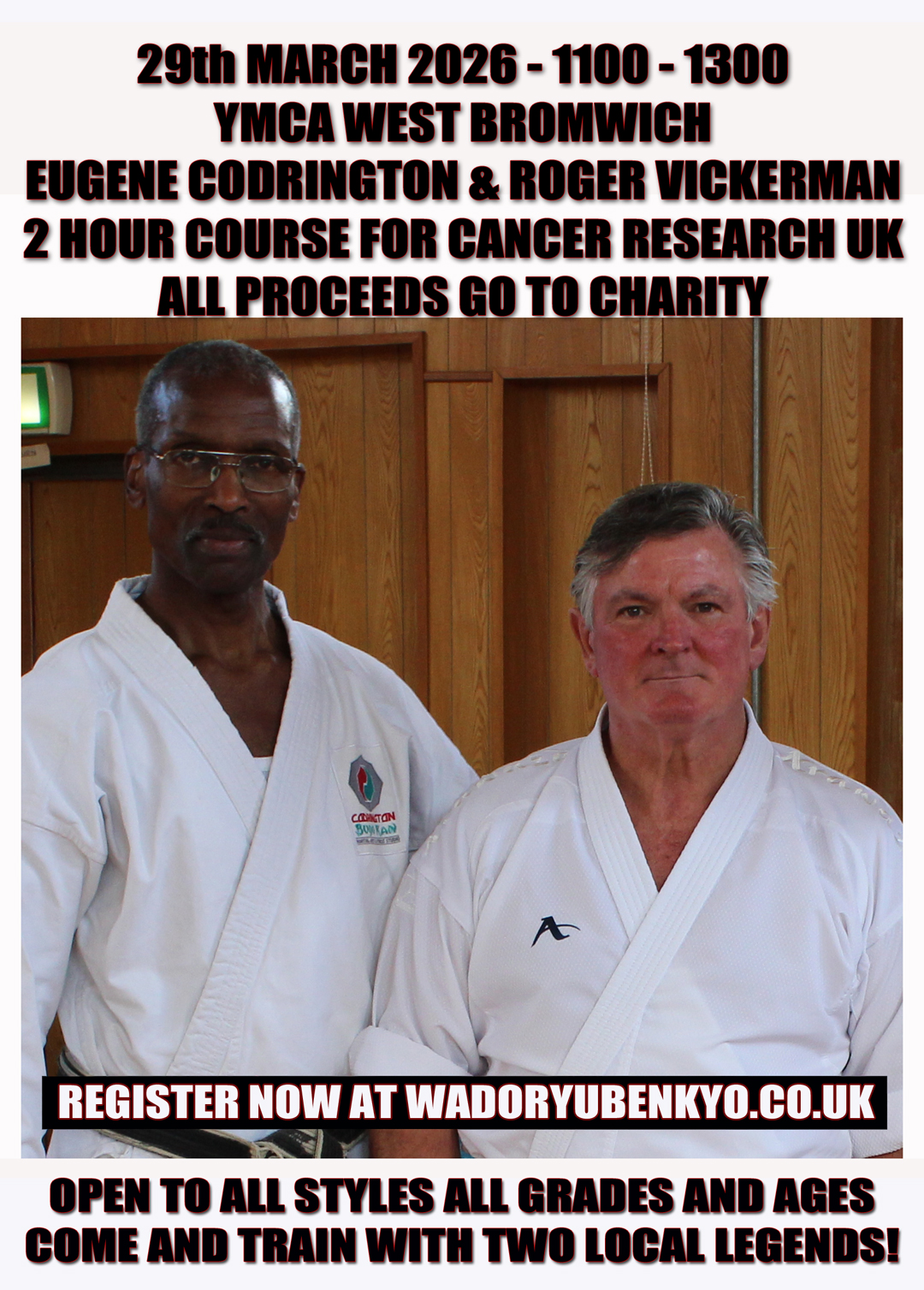
- 29th March 2026 Joint Charity Course with Eugene Codrington — details here
- May 2026 course dates confirmed — book here
- October 2026 course available — details here
🧠 5. Wadō-Ryū Principle of the Week
Nejire (捻れ)
In Wadō-Ryū, nejire means torsion — the twisting potential you create through the body, then release at the right moment to produce efficient power without forcing technique.
Many practitioners use torsion on nearly every movement without realising it. The problem is simple: if you aren’t aware of it, you can’t make the most of it. The aim here is not to turn training into a “sweat session”, but to train with a project: identify where torsion is created, where it is released, and how to use it without damaging your body.
Why Nejire Matters (Especially as We Get Older)
Speed and athletic spring reduce with age — tendons resist, recovery slows, and forcing technique becomes costly. The answer is not “try harder”; the answer is to box clever: find the small places where you can generate potential power, then release it cleanly as kinetic power.
- Potential — where power is generated and stored.
- Kinetic — where power is released.
The skill is not holding torque for too long, and not “muscling” it into place. Nejire must be created briefly and released naturally — with relaxation, then kime only at the point of contact.
Nejire in Junzuki (The Twist You Can’t See)
Most people perform junzuki as a visible “step and punch.” Nejire changes this. The twist is inside — subtle — and it’s released as you land.
Think of it like a spring: fixed at one end, twisted, then released. In junzuki, the hip is held back slightly as the body travels, creating stored potential. As the technique lands, the stored twist is released and the strike is thrown — not forced.
Key teaching points
- Relax first. If you are tense, the technique becomes staged and mechanical.
- Create the stretch. The twist is generated as the body travels — not added as an extra move.
- Release on landing. Let the torque go as the technique arrives.
- Don’t punch “hard”. Focus on how you use the punch — not brute force.
- Shrug off tension afterwards. Switching on/off keeps you training longer.
Nejire is not something you do “before” the technique — it’s something you become aware of during the technique.
Spiral Lines and the “Boiled Egg” Fist
The body does not work as straight lines only. Muscles form natural spiral lines through the torso, hips and legs. When you relax, those spiral lines can work as they are designed to work. When you tighten too early, you choke the movement.
A useful reminder: do not over-clench the fist. Too much tension in the hand spreads to the forearm, shoulder and posture. Think of holding a boiled egg in the fist — not crushed, not dropped.
Where Torsion Starts (Timing Awareness)
One of the most important questions is when torsion starts. In junzuki, it begins as the body is travelling — and becomes more noticeable once the back foot passes the front foot. Awareness of timing prevents you from “adding” torsion as an extra stage (which becomes mudana).
Nejire in Sonobade and Gyakuzuki
Sonobade (widening the stance for reverse action) is often taught as “move the foot, then punch.” Instead, drop the hip and let the body find the natural lock-point — when the hip can’t move any more, you release the anchor and the punch starts earlier.
Practical cues
- Drop the hip to create torsion.
- Keep the foot close to the floor — “rice paper thickness.”
- Release the anchor to let the strike begin earlier (not staged).
- Don’t oscillate side-to-side. Maintain forward intent and posture.
This connects directly into kata mechanics: seishan, yoko seishan, and the basic version — naihanchi. One movement can train multiple disciplines if you understand what it is actually doing.
Tate Seishan: 50/50, Centre Line, and Moving the Head First
Tate seishan is central because it’s balanced — fifty-fifty — allowing movement in any direction. It also keeps kicks and transitions on the centre line, rather than shifting the centre across the body.
When facing attacks to the head, the first movement is not “feet first” — it is the head and centre. Your legs can follow, but the body weight must lead. This is the same logic you see in boxing: protect the computer, because the rest doesn’t work if it’s damaged.
Nejire in the Arms: Gaiwan / Naiwan (Not “Blocks”)
Torsion does not only occur in the hips and legs. It also exists in the arms — especially in receiving actions like gaiwan and naiwan. The principle is not collision, but contact and redirection. “Block” is a block of wood; receiving is about not getting hit.
The twist is not only in the wrist — it’s through the elbow and the line of the arm, supported by the torso. Make contact first, then rotate. Contact becomes information; information becomes control.
Two ways of expressing naiwan
- Hip + wrist — turn the body and rotate through the arm to create kuzushi (breaking centre).
- Drop-in hip — enter and destroy the centre while the arm rotates (seen clearly in kata).
What to Take Away
This is not about making karate complicated. It is about extending your Wadō life by training smarter: finding the torsion inside the technique, releasing it at the right moment, and avoiding the damage that comes from holding torque too long.
- Relaxation enables speed.
- Torsion is created briefly; kime appears only at contact.
- Nejire is inside the technique, not an added stage.
- One principle can connect kihon, kata and kumite together.
Glossary: Nejire(捻れ)
🙏 Thank You for Being Part of the Community
If you have any questions, video requests, or feedback, simply get in touch — we read everything.
Wishing you a fantastic week of training,
Roger and The Team
Wadō-Ryū Benkyō